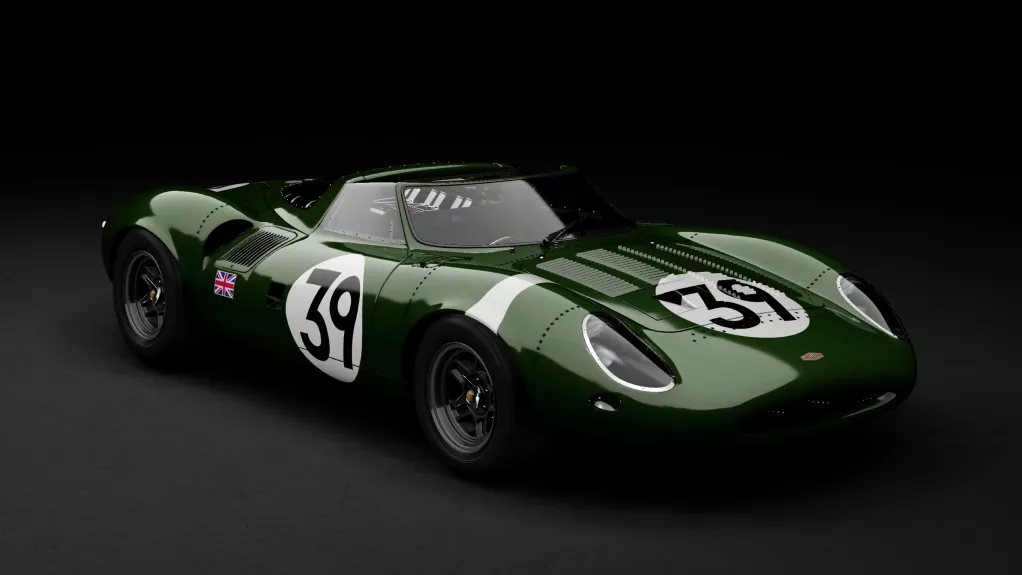
 WSC60 Legends, 1966, Great Britain
WSC60 Jaguar XJ-13
3d Model Conversion by: MacedoSTI With five wins between 1951 and 1957 (two by C-types and three by D-types), Jaguar were the most successful manufacturer to participate at Le Mans during the 1950s. Jaguar were best known for their smooth and powerful straight six engines, but a dual overhead camshaft V12 had long been under consideration. Such an engine finally came to fruition in July 1964 with a view to spawning a single overhead cam derivative for production use. 1964 was a watershed season for sportscar racing. Ferrari had largely dominated the scene since Jaguar’s exit, but a new Anglo-American challenger emerged at the Le Mans Test that April: the Ford GT40. Henry Ford II had sanctioned the multi million dollar GT40 programme after Enzo Ferrari reneged on a deal to sell his company. Thus began perhaps the greatest battle in sportscar history. Compared to the single cam Ferrari V12 and Ford’s pushrod V8, the new Jaguar V12 seemed to have an edge. Understandably, the competition department in Coventry thought it the ideal power unit for an all new prototype racing car that could return Jaguar to Le Mans. A small team started work on designing a brand new mid-engined chall